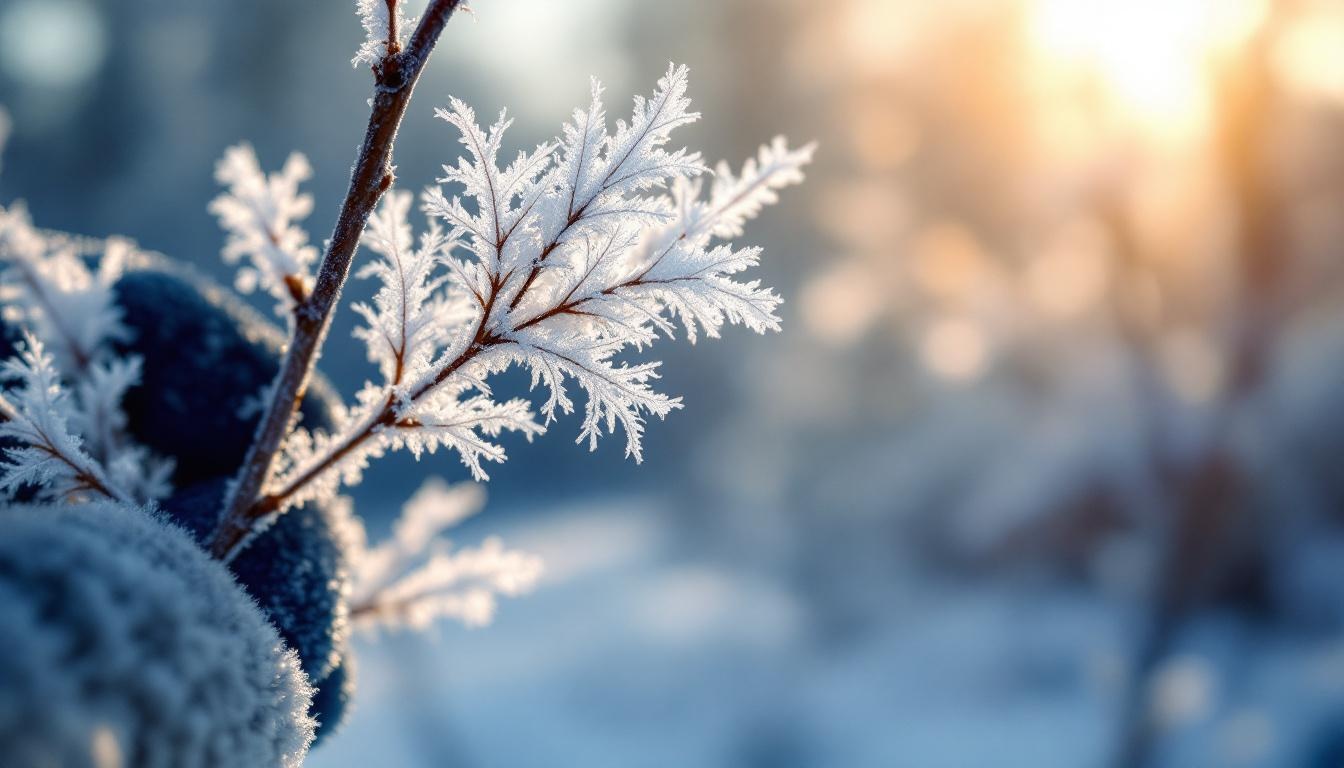
Winter’s arrival typically sends macro photographers indoors, convinced that cold weather spells doom for close-up work. Yet this seasonal retreat represents one of photography’s greatest missed opportunities: cold conditions actually create superior macro environments that outperform summer shooting in measurable ways.
The atmospheric physics of cold air, combined with winter’s unique moisture patterns and biological rhythms, generates ideal macro conditions that remain largely untapped by photographers who assume warmer months hold all the advantages.
The Physics of Cold Weather Clarity
Cold air fundamentally transforms optical conditions in ways that benefit macro photography. Dense, cold air molecules create less atmospheric distortion than their warm-weather counterparts, resulting in measurably sharper images at close focusing distances.
When temperatures drop below 40°F (4°C), atmospheric turbulence decreases significantly. The National Weather Service explains that temperature inversions common in winter create stable air masses that minimize the heat shimmer and atmospheric distortion that plague summer macro work. This stability translates directly into improved optical performance at magnifications above 1:2, where even minute atmospheric interference becomes visible.
Temperature ranges between 20-35°F (-6 to 2°C) optimize these conditions while remaining manageable for equipment operation. Below 20°F, battery performance degrades rapidly, while above 35°F, the atmospheric benefits diminish as air density decreases.
Humidity levels between 60-80% during cold conditions create natural diffusion without the harsh contrasts of dry winter air. This moisture acts as a massive softbox, wrapping around macro subjects to eliminate harsh shadows while maintaining detail clarity that artificial diffusion often sacrifices.
Winter’s Natural Subject Enhancements
Cold weather transforms macro subjects in ways that enhance photographic possibilities rather than limiting them. Frost formation creates intricate crystalline structures on leaves, spider webs, and small objects, adding textural complexity impossible to replicate artificially.
Condensation patterns develop differently in cold air, creating water droplets with more uniform size distribution and longer persistence. These droplets remain stable for extended shooting sessions instead of rapidly evaporating as they do in warm conditions. The slower evaporation allows precise positioning and composition adjustment without losing the effect.
Ice crystal formation on surfaces provides geometric patterns and light refraction opportunities that serve as natural macro lenses. Thin ice layers on puddles create abstract backgrounds with controllable reflective properties, while hoarfrost develops delicate branching structures that add depth to compositions.
Winter’s reduced foliage eliminates background clutter that competes for attention in macro compositions. Bare branches create clean, geometric backgrounds that emphasize main subjects without the visual noise of dense summer growth. This natural simplification often produces stronger compositions than careful background selection in cluttered warm-weather environments.
Biological Advantages of Cold Weather Macro
Cold temperatures slow insect metabolism, creating photography opportunities unavailable during active warm seasons. Moths, beetles, and other small subjects become docile and approachable when temperatures drop below their activity thresholds, typically around 50°F (10°C) for most species.
This temperature-induced torpor allows macro photographers to work at higher magnifications with longer setup times. Subjects remain stationary for minutes rather than seconds, enabling precise focus stacking, lighting adjustment, and composition refinement. The University of Minnesota’s Department of Entomology notes that insect behavior changes predictably with temperature making their winter photography more reliable than warm-weather encounters.
Early morning conditions, when temperatures hover just above freezing, provide the optimal window. Insects remain sluggish enough for close approach but haven’t yet entered full winter dormancy that makes them completely inactive.
Plant subjects also benefit from cold conditions. Seed pods, dried flowers, and evergreen details develop enhanced textures in winter air. Pine needles collect frost and ice that highlight their geometric arrangements, while dried grasses maintain structural integrity longer in cold conditions than in the decay cycle of warm, humid environments.
Technical Considerations for Winter Macro Performance
Cold weather demands specific equipment adaptations that, once mastered, actually improve shooting efficiency. Battery performance drops significantly below 32°F (0°C), with lithium-ion batteries losing 20-40% capacity. Carrying batteries in inside jacket pockets maintains their temperature and performance, while external battery grips provide longer shooting sessions.
Condensation management becomes critical when moving equipment between temperature zones. Allowing gear to acclimate gradually prevents internal fogging that can sideline shooting sessions. Placing equipment in sealed bags during temperature transitions, then allowing 30-60 minutes of gradual warming, eliminates condensation problems that plague unprepared winter shooters.
Lens performance actually improves in cold conditions for most modern macro lenses. Glass contracts uniformly, reducing internal aberrations, while autofocus motors operate more precisely in the stable temperatures. Manual focus rings provide more tactile feedback in cold air, improving focusing accuracy for critical macro work.
Tripod stability increases in cold conditions as thermal expansion effects diminish. Carbon fiber legs perform better than aluminum in extreme cold, maintaining structural integrity without the brittleness that affects some materials below freezing.
Optimizing Winter Macro Shooting Conditions
Post-storm conditions create exceptional macro opportunities as clearing weather systems leave optimal humidity and atmospheric clarity. The 24-48 hours following snow or ice storms provide peak conditions: clean air, high contrast lighting, and subjects enhanced with natural ice formations.
Clear, cold mornings offer the most predictable shooting windows. Temperature stability from pre-dawn through mid-morning maintains frost and ice formations while providing gentle, directional lighting that enhances macro subject textures.
Wind considerations become more critical in winter macro work. Cold air carries more effectively than warm air, making windbreaks essential for magnifications above 1:1. Natural windbreaks like building corners or dense evergreens provide steady conditions that would be unnecessary in calmer warm weather.
Regional weather patterns create predictable opportunities for macro photographers who understand local climate cycles. Areas with consistent freeze-thaw cycles provide repeated opportunities for ice and frost formations, while regions with stable cold periods offer different but equally valuable shooting conditions.
Timing Seasonal Opportunities
Different winter macro subjects peak at specific temperature ranges and seasonal timing. Early winter (December-January in northern climates) provides the best evergreen detail shots as needles maintain their structure before winter damage accumulates.
Mid-winter offers peak ice formation opportunities. Temperatures cycling around the freezing point create varied ice textures from thin glazes to thick accumulations, each providing different photographic possibilities.
Late winter presents unique opportunities as lengthening daylight combines with continued cold conditions. Subjects begin showing subtle changes that signal approaching spring while maintaining winter’s optical advantages.
Understanding local seasonal patterns enables photographers to predict optimal conditions rather than hoping for accidental discoveries. Weather service frost predictions, combined with humidity forecasts, provide advance planning tools that improve shooting success rates significantly.
Equipment Investment Decisions
Cold weather macro photography rarely requires specialized equipment beyond basic weather protection. Standard macro lenses perform excellently in cold conditions, often better than in temperature extremes of summer heat.
Weather sealing becomes more valuable in winter conditions where moisture transitions between liquid and solid states create challenging environmental conditions. However, basic protection measures often suffice: lens hoods, UV filters for front element protection, and microfiber cloths for clearing condensation.
Lighting equipment performs reliably in cold conditions, with LED panels actually improving efficiency in low temperatures. Ring lights and macro flash units operate normally down to 0°F (-18°C) in most cases, expanding beyond their warm-weather performance ranges.
The decision between cold-weather gear purchases and technique adaptation usually favors technique development. Learning proper condensation prevention, battery management, and timing optimization provides better return on investment than specialized cold-weather equipment for most photographers.
- Cold air below 40°F creates superior optical clarity by reducing atmospheric distortion and heat shimmer effects
- Winter moisture patterns produce natural diffusion and unique textures (frost, ice crystals) that enhance macro subjects
- Low temperatures slow insect movement, enabling precise focus and composition at higher magnifications
- Reduced winter vegetation eliminates background distractions for cleaner, more impactful compositions
- Proper battery management and condensation prevention techniques are essential for reliable cold-weather performance
- Post-storm conditions and clear cold mornings provide the most predictable optimal shooting windows