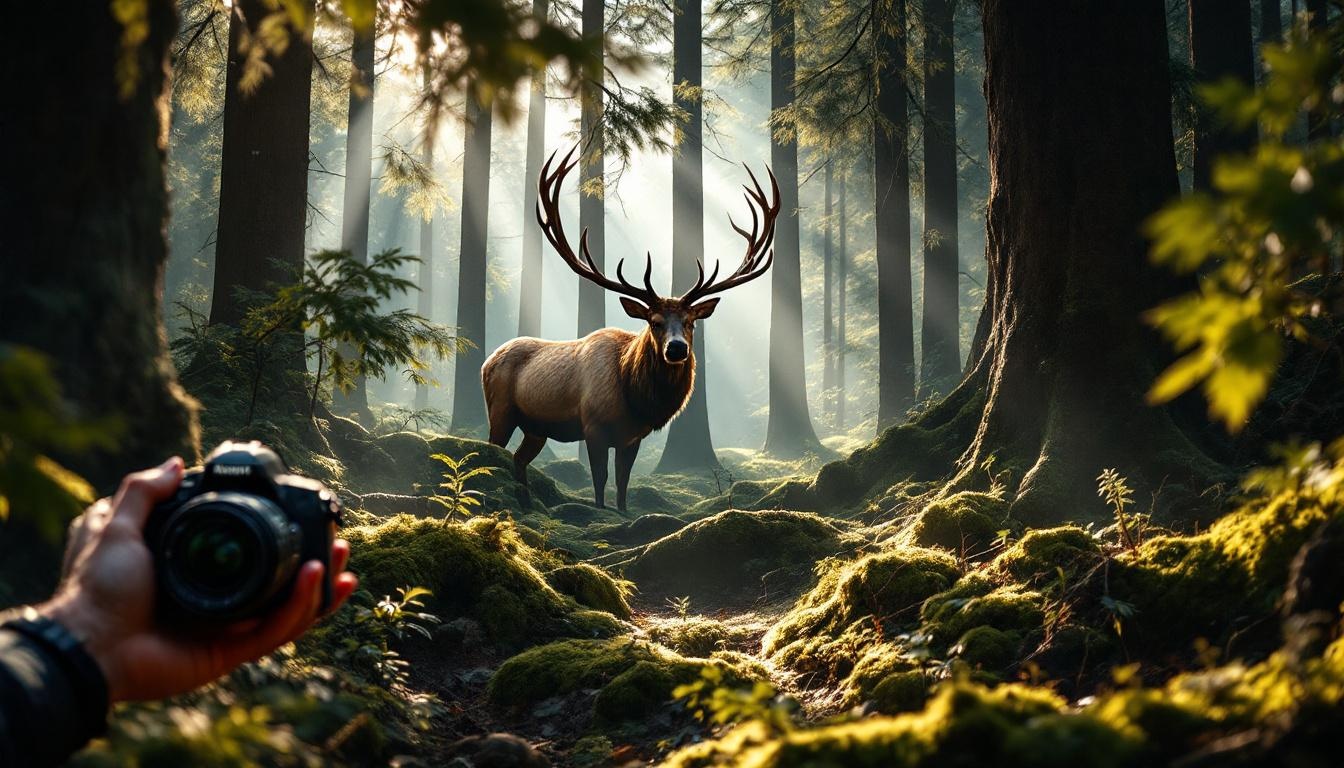
Professional wildlife photographer Sarah Chen stood motionless in the old-growth cedar grove, watching a Roosevelt elk emerge from the shadows 40 feet away. Her camera’s auto ISO system had just jumped to 12,800 in response to a bright patch of sky visible through the canopy above, leaving the magnificent animal underexposed in the forest’s perpetual twilight. That moment crystallized what many veteran forest photographers have discovered: auto ISO systems consistently fail in the complex lighting conditions where North America’s most sought-after wildlife actually lives.
This technical limitation has prompted a significant shift among professional nature photographers working in dense forest environments. Rather than relying on sophisticated camera automation, they’re returning to manual ISO control paired with spot metering techniques that prioritize subject illumination over overall scene brightness.
The Physics Behind Forest Light Failure
Dense forest canopies create lighting conditions that confound even the most advanced camera metering systems. In Pacific Northwest old-growth forests, towering Douglas fir and western red cedar trees filter 85 to 90 percent of available light before it reaches the forest floor. The remaining illumination arrives as a patchwork of bright spots and deep shadows that shift constantly with wind movement.
Camera manufacturers design auto ISO systems to maintain overall scene exposure based on matrix or center-weighted metering patterns. These systems excel in evenly lit conditions but struggle when bright sky patches occupy significant portions of the frame. The camera’s meter reads the bright canopy openings and reduces ISO settings to prevent overexposure, inadvertently underexposing wildlife subjects positioned in the shadowed areas where they naturally occur.
Research from the USDA Forest Service confirms that forest understory light levels typically measure 2 to 4 stops dimmer than the brightest canopy patches visible in the same frame. This dramatic range exceeds the compensation ability of most camera metering systems, forcing photographers to choose between properly exposed subjects and acceptable highlight retention.
Manual ISO: The Professional Solution
Experienced forest photographers solve this problem by pre-selecting ISO values based on ambient understory light rather than allowing the camera to react to mixed lighting conditions. This approach requires accepting higher noise levels in exchange for consistent subject exposure and predictable results.
The technique involves three critical steps: measuring light levels in the shadowed areas where wildlife appears, selecting an appropriate manual ISO setting for those conditions, and using spot metering on the subject itself rather than evaluative metering patterns that factor in bright background elements.
Modern full-frame cameras perform remarkably well at ISO settings that would have been unusable five years ago. Professional-grade sensors from Canon, Nikon, and Sony maintain acceptable noise characteristics through ISO 6400, with many photographers routinely shooting forest wildlife at ISO 3200 to 5000 without significant image quality degradation.
Regional Forest Conditions and ISO Strategy
Different forest types across North America require distinct ISO approaches based on canopy density and seasonal light transmission patterns. Eastern deciduous forests present unique challenges as leaf coverage varies dramatically between seasons, creating 2 to 3-stop exposure differences between summer and winter conditions.
During peak leaf coverage in July and August, mature hardwood forests in regions like the Appalachian Mountains or Great Lakes states often require ISO settings of 2000 to 4000 for wildlife photography, even during midday hours. The same locations in December with bare branches may allow ISO 800 to 1600 for equivalent results.
Tropical and subtropical forest environments present the most challenging conditions for wildlife photographers. Multi-layered rainforest canopies in locations like Olympic National Park’s Hoh Rain Forest or Florida’s Everglades hardwood hammocks can reduce light levels so dramatically that ISO 4000 to 6400 becomes necessary even in bright midday conditions.
Implementing Manual ISO Technique
The transition from auto ISO to manual control requires developing new metering habits and recalibrating expectations about acceptable image noise. Professional photographers recommend starting this process in familiar local forest areas where lighting conditions are predictable.
Begin by taking spot meter readings from shadowed areas similar to where wildlife subjects typically appear. Tree trunks, fallen logs, and forest floor debris in shade provide good reference points for establishing baseline ISO settings. Set the camera to manual ISO at a level that provides proper exposure for these shadow areas, typically 2 to 4 stops higher than what auto ISO would select for the overall scene.
Spot metering becomes essential when using manual ISO in forest conditions. Switch the camera’s metering pattern to spot mode and practice placing the metering point directly on wildlife subjects rather than allowing the meter to average across bright and dark areas. This technique ensures consistent subject exposure regardless of background lighting variations.
Common Technical Mistakes
Many photographers attempting manual ISO control make predictable errors that compromise their results. The most frequent mistake involves insufficient ISO settings based on fear of image noise. Photographers accustomed to shooting at ISO 400 to 800 in open conditions often select ISO 1200 to 1600 for forest work, which remains inadequate for proper subject illumination in dense canopy conditions.
Another common error occurs when photographers fail to adjust ISO settings while moving between different forest density zones during a single shooting session. A setting appropriate for forest edge conditions becomes inadequate 200 yards deeper into old-growth timber, yet many photographers maintain the same ISO throughout their session.
Center-weighted and matrix metering patterns compound these problems by incorporating bright canopy patches into exposure calculations. Even with manual ISO settings, these metering modes can lead to inconsistent results when background lighting changes dramatically.
Equipment Considerations and Noise Management
Camera sensor technology has advanced to the point where ISO 3200 to 6400 produces acceptable results for most wildlife photography applications, but lens selection becomes more critical in forest conditions. Fast telephoto lenses with maximum apertures of f/2.8 or f/4 allow lower ISO settings while maintaining adequate shutter speeds for wildlife movement.
Post-processing noise reduction software has also improved dramatically, making higher ISO settings more viable than many photographers realize. Modern tools like DxO PureRAW or Topaz DeNoise AI can effectively clean up images shot at ISO 4000 to 6400 without significant detail loss, expanding the practical range for forest photography.
Professional wildlife photographers emphasize that slight image noise is far more acceptable than underexposed subjects that require extensive shadow lifting during post-processing. Brightening underexposed images introduces more visible noise and color artifacts than shooting at higher ISO settings from the start.
National Park and Wildlife Refuge Considerations
Most national parks and wildlife refuges prohibit flash photography to avoid disturbing animals, making high ISO techniques essential for ethical wildlife photography in forest environments. The National Park Service specifically restricts artificial lighting that might alter animal behavior, forcing photographers to work with available light conditions.
These restrictions make manual ISO control even more important for photographers working in protected areas. Auto ISO systems that consistently underexpose subjects create pressure to use prohibited lighting techniques or engage in excessive post-processing that degrades image quality.
Professional photographers working in these environments routinely accept ISO settings of 4000 to 8000 to maintain ethical shooting practices while capturing publication-quality images. The slight increase in image noise is considered an acceptable trade-off for proper subject exposure and wildlife welfare.
Measuring Success and Making the Transition
Photographers considering the switch from auto ISO to manual control should evaluate their current success rate in forest conditions. If more than 20 percent of forest wildlife images require significant shadow brightening during post-processing, manual ISO techniques will likely improve results.
The transition period typically involves 4 to 6 shooting sessions to develop comfort with higher ISO settings and new metering habits. Professional photographers recommend starting with familiar local forest areas where lighting conditions are predictable before attempting the technique in unfamiliar locations or with rare wildlife subjects.
Success metrics should focus on consistent subject exposure rather than minimal image noise. A properly exposed image at ISO 4000 will consistently outperform an underexposed image at ISO 1600 that requires extensive post-processing correction.
- Auto ISO systems fail in forest conditions because they react to bright canopy patches rather than shadowed wildlife subjects
- Manual ISO control allows consistent subject exposure by pre-selecting settings based on understory light levels
- Modern cameras produce acceptable results at ISO 3200-6400, making higher settings practical for forest wildlife photography
- Spot metering on wildlife subjects prevents bright background elements from influencing exposure decisions
- Different forest types require adjusted ISO strategies based on canopy density and seasonal variations